
Discover exceptional villas and personalized concierge services for a seamless Los Cabos getaway.
Your request has been received. One of our villa experts will contact you shortly.
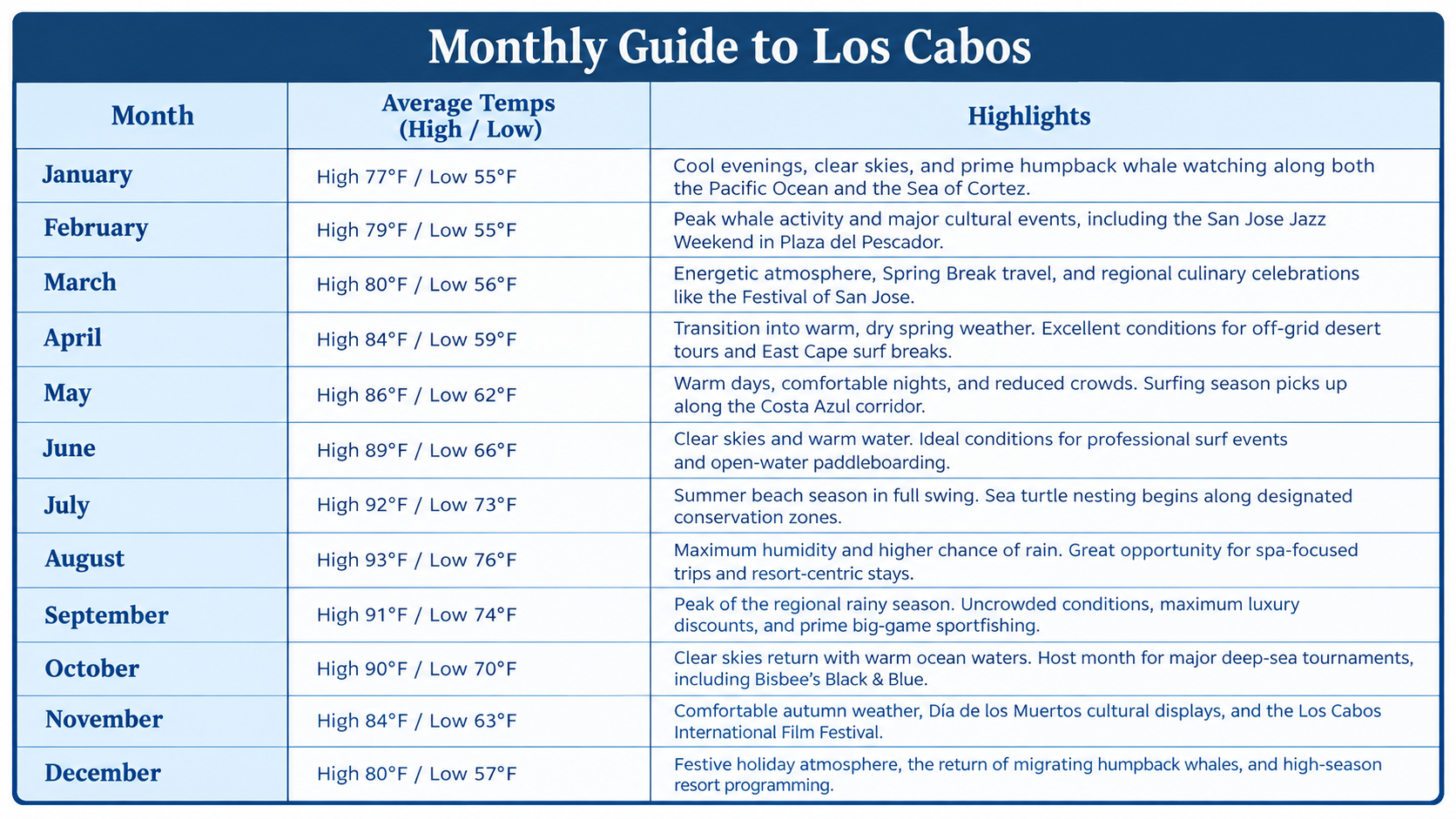
Quick answer: The best time to visit Cabo San Lucas is April through June and late October through November. These shoulder months deliver dry, 80–90°F days, calm seas, thin crowds, and villa rates well below peak winter pricing. The worst months to go to Cabo are August and September, when humidity peaks, rain concentrates, and Pacific storm risk is highest. If whale watching is your priority, visit mid-December through mid-April instead.
Los Cabos gets more than 350 sunny days a year, so there is no truly bad week here, only trade-offs between weather, price, and crowd size. This guide breaks those trade-offs down month by month so you can book the exact window that fits your trip.
Cabo San Lucas sits in a desert that meets the sea, which is why it stays dry while mainland Mexican beach towns get soaked. Average annual rainfall totals under 10 inches, and more than half of it falls in just two months.
Temperature and precipitation averages sourced from the National Climatic Data Center.
Two patterns jump out. First, March through June is functionally rainless, under a tenth of an inch across four months. Second, August and September account for roughly 60% of Cabo’s yearly rainfall, which is the single clearest reason those months rank last.
Ask a repeat traveler for the best month to visit Los Cabos and you’ll usually hear May or June. Here’s why that window wins:
April is the bridge month: temperatures in the mid-80s, whale season tailing off through mid-April, and Easter week the only real crowd spike. If you want warm water plus the last chance at a humpback sighting, the first half of April is the sweet spot.
Fall is Cabo’s most underrated season, and for snorkelers and divers it may genuinely be the best.
Cooler evenings return.
November nights drop into the low 60s, perfect for terrace dinners and open-air villa living.
November also brings Día de los Muertos altars in San José del Cabo’s Art District and the Los Cabos International Film Festival. Book early: hotel and villa rates start climbing by mid-November as peak season approaches.
If budget drives your decision, July, August, and September deliver the deepest discounts of the year, often 30–50% below winter rates at the same property. Five-star resorts and private villas that are impossible to book in February become surprisingly attainable.
What you’re trading:
What you’re gaining: near-empty beaches, restaurant tables without reservations, and a private villa at shoulder-season pricing. For travelers who plan to spend their days in a pool with an ocean view, it’s a legitimate value play — as long as you buy travel insurance and watch the forecast.
A gentler discount option: May and early June give you 80% of the savings with almost none of the weather risk.
These are the two months to avoid if weather matters most. August is the hottest month of the year, September the wettest. Together they carry the highest practical storm risk of the year.
The Eastern Pacific hurricane season officially runs May 15 to November 30, but the real risk window for Los Cabos is much narrower: late August through early October. Cabo’s position at the tip of the Baja peninsula means it far more often gets tropical storms — wind, a day or two of rain, then blue sky — than direct hurricane landfall. Direct hits are rare but not unheard of, which is why travel insurance is non-negotiable in this window.
Learn More About Hurricane Season
March isn’t bad weather-wise — it’s one of the driest months on the calendar. It’s bad for a different reason: spring break. From late February through early April, US student travel floods downtown Cabo. If you’re planning a family trip, an anniversary, or a quiet villa week, this is the season to skip.
Peak season brings ideal 77–80°F days and the highest rates and occupancy of the year. Nothing is wrong with winter in Cabo, it’s simply the most expensive and most crowded way to experience it.
Many Los Cabos beaches are not safe for swimming at any time of year, regardless of how calm they look. Steep drop-offs, heavy shore break, and strong undertow are common on the Pacific side. Stick to protected, swimmable beaches Médano, Chileno, Santa María, Palmilla, and Acapulquito, and never enter the water without checking for a green safety flag. Warm water does not mean safe water.
What is the best month to visit Cabo San Lucas?June is the strongest single month: no measurable rain, warm water, thin crowds, and value pricing before July humidity sets in. May and November are close seconds.
What are the worst months to go to Cabo?August and September. They combine the year’s highest heat and humidity, roughly 60% of annual rainfall, and the peak of Pacific storm risk.
Is Cabo rainy?
Rarely. Cabo San Lucas is one of the driest coastal destinations in North America, averaging under 10 inches of rain a year, most of it in late summer.
When is the cheapest time to fly and stay in Cabo?
July through September, with discounts commonly reaching 30–50% off peak rates.
When can you see whales in Cabo?
The humpback season runs roughly December 15 to April 15, with peak sightings in January, February, and March.
How many days should you spend in Cabo?
Three to four days is enough for a first visit. A full week is better if you’re traveling a long distance or renting a private villa.
Browse available villas or contact our concierge team to match your travel dates with the right property. Booking shoulder season? Reach out early, our best villas for May, June, and November go first.